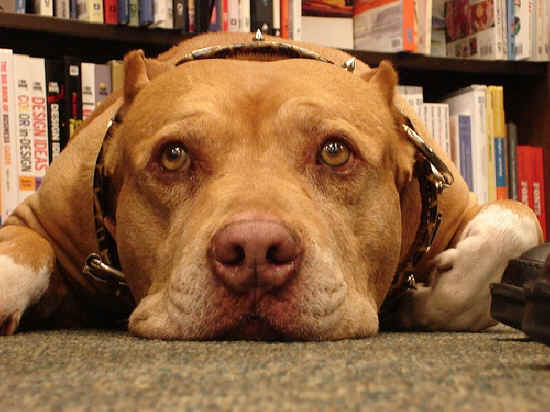
Cesar Millan's beloved Pit Bull "Daddy" dies at 16 years of age. Daddy, the mild-mannered Pit bull who assisted Cesar Millan in countless dog rehabilitations, died on Friday February 19, 2010. Daddy had been with Cesar since he was just 4 months of age.Daddy was instrumental in many of Cesar's most difficult cases - his calm, even demeanor made him the ideal dog for helping out of control dogs find balance.Perhaps even more importantly, Daddy became an ambassador for his much maligned breed. All too often, pit bulls in the news are portrayed as unstable, vicious killers. Daddy helped to dispel this image as he repeatedly tolerated even the most wildly out of control dogs with stability and calm-submissive behavior.Daddy was frequently in the public eye, consistently showing off his calm, well-balanced demeanor on the hit series, the "Dog Whisperer".At the Cesar's Way website, there is an update on Daddy's passing. The news posting states that not only is Cesar Millan and his family in mourning over the loss of Daddy, but so are his staff, friends, and volunteers. Daddy touched many lives in a beautiful and positive way.Fans of Daddy who would like to make a donation in his memory can do so by donating to Daddy's Emergency Animal Rescue Fund. The fund has been created to help provide assistance to dogs who have been the victim of abuse, suffered from man-made disasters such as puppy mills, and also, for victims of natural disasters such as hurricane Katrina.Daddy lived an impressive 16 years, successfully battling cancer and enduring chemotherapy treatments. He was surrounded by those who loved him when he passed. Hopefully his protege, Junior, will be able to carry on Daddy's excellent work. He certainly has big paws to fill.Rest in peace Daddy - you've earned your place over the Rainbow Bridge.
~ ~ ~ ~ ~ ~ ~ ~ ~ ~ ~
It's been told a photograph says a thousand words. This one united a thousand hearts. One snapshot captured the desperation of a dog, the state of animal shelters and the fate of too many canines housed there. In a word, the picture of Nico is epically heartbreaking. This six-year-old Dogo Argentino is shown with bowed head, leaning against his kennel wall, looking like a beaten, depressed, dejected and forgotten creature. Perhaps you've seen it. If you have, you haven't forgotten.
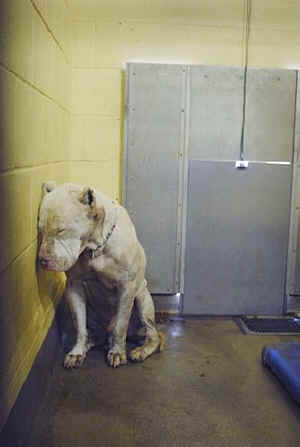
This is how Nico looked in the shelter. Nikki Audet's photo caused a huge Internet wave that eventually saved Nico's life.The story might have ended there. But when rescue volunteer and photographer Nikki Audet with The Mutt Scouts posted the photograph online to garner attention and hopefully spark someone into action, something amazing happened. Nico's picture went viral, starting with Facebook. Suddenly, he became the unofficial poster dog for homeless canines, reminding rescuers who they fight for every single day. And Nico needed that kind of fight. He was a mess: depressed, malnourished, beaten up, bloody, deaf and a "bully breed" to boot. He also had a large tumor on his back, even more visible due to his emaciated frame. He didn't stand a chance of getting out of the shelter. Until that photo of him went gangbusters. As also stated in an L.A. Unleashed article written by Orange County journalist Janet Kinosian, a rescuer named Kelly Gibson from San Diego saw Nico's portrait, and acted on it. She operates a small rescue out of her home called Puggles and Pitties and is very active in animal transport. The dogs she rescues are either rehomed by her or transported to other rescue facilities that can adopt them out. Gibson is no stranger to the shelter reality, but seeing Nico's picture affected her deeply. "So much emotion was conveyed in that picture," she said. "He looked so defeated and had totally given up on life. He had lost all hope. He had a rough life and now found himself in the awful South L.A. shelter. Things were going from bad to worse, and I knew he had no chance of making it out alive. He seemed to know it, too. Plus, the shelter had noted on his record that he was dangerous, a biter, aggressive. But all I saw was a dog that had gotten a really bad chance at life." She traveled to Los Angeles to meet Nico, armed with plans to adopt him herself, take him to her own vet and have him humanely euthanized. "I just couldn't stand the thought of no one showing him a simple kindness in his life and thought he deserved to die with more dignity and respect than he would ever be shown in the shelter," Gibson said. But the minute she walked up to his kennel and looked into Nico's soulful, bi-colored eyes, Gibson knew this dog was not just misjudged, but full of life. He gave her kisses and, despite being sick and filthy, acted sweet as a lamb. Gibson knew right then that this dog needed help, and she was going to make it happen. "I changed my plan and decided he needed to be given a chance at life and not just put down," she said. Thanks in part to money raised by Audet, Gibson worked with The Mutt Scouts and bailed Nico out of Los Angeles' South Central animal shelter. He went into veterinary care as he waited for Gibson to coordinate his transportation to the Humane Society for Hamilton County in Noblesville, Ind. She has worked with the shelter's executive director, who has a soft spot for Pits, and together, they arranged for Nico's new life. It took weeks and 45 people to finesse the cross-country deal, but it happened. Nico arrived at the humane society safe and sound. There, he began his training and rehabilitation in search of his forever home. But who knew his journey to a new life would also inspire so many others along the way? "He has touched many hearts and he is even changing people's minds," said Deena Hitchens Crouch, a board members with the Humane Society for Hamilton County. "After meeting Nico, [people] couldn't believe how gentle and sweet he was, especially after what he had experienced." And what he experienced was a terrible life of neglect and abuse on the streets. Scary enough for any dog, but for a deaf dog, the days and nights must have been endless. Thanks to his foster care through The Invisible Fence company, Nico worked extensively with trainer and foster mom Julie Case to get him acquainted with rules, manners and commands. Showing what a smart dog he is, Nico picked up his lessons quickly.
A new life!
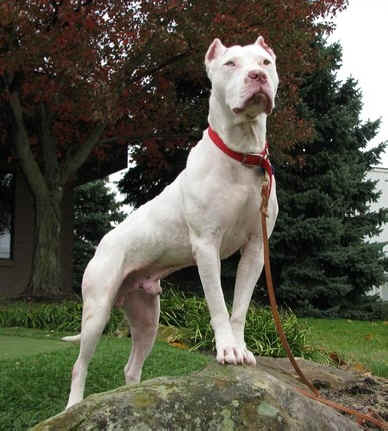
In November 2009, Nico was nearly ready for a forever home. The majestic boy had come so far. He looked like a different dog from the one that sparked his life-saving Internet campaign. Many people, having seen that photo, wanted to adopt Nico, but the one who eventually did had no idea that this dog was a celebrity of sorts. Meet Bridget Swan of Indianapolis. She and her partner Melissa Garris were looking for a special-needs bully-breed dog to adopt, and so a co-worker sent Swan the Hamilton County Humane Society's page on Nico. It was the first Swan had seen of this survivor. She immediately fell for him. "I always root for the underdog," Swan said. "Seeing [Nico's] picture and reading his story on the HSHC website made me want to rescue him and provide a good, stable environment for the rest of his days. When I called and asked if I could go for a visit, I could not believe he was still available. He has a spirit about him and I think that is what attracted me to him once I actually met him." Swan raced down to the shelter the next day to meet him and fill out paperwork. She was surprised when, initially, the shelter was not keen on adopting Nico out. The staff feared he would be pursued based on his popularity, so they made sure Swan wanted Nico, not just Nico the Internet Dog ("He has a Facebook page," Swan added with a laugh). Once they realized she was legit, Nico was hers. And they've all been bonded ever since. Swan and Garris work with a vibration collar so they can "call" his name; he'll immediately trot over to them and sit right down. "He has been trained, and is still training, with hand signals," said Swan. "He is doing so well!" Even though he faced mistreatment and abuse in the past, Nico holds no grudges in the present. "[Despite] Nico's scarring and the condition he was found in, he has forgiven man for everything that has happened to him," said Swan. "He is truly an example of a happy ending, even though this just our beginning." On one side, Nico behaves like a true gentleman. Yet on the other, he's still just a big guy. "He loves to sleep, snore, play in the snow, cuddle, snort and pass gas," Swan joked. "He is so amazing and has added so much stinky love to our lives!" He adores the snow, chewing, sleeping and his baths. Oh how he loves his baths! But perhaps the best thing Nico loves to do is snuggle. "He and I have started snuggling in the morning," said Swan. "It is so cute, I cannot put it into words." Nico is an original, and his story is a success. From street dog to death-row dog to rescued canine to adored family member. But everyone involved in his journey knows that there are lots of other Nicos in shelters all across the country, just waiting for their happy endings. "When someone goes to a shelter to find a pet, they are looking for the cute, well-maintained, spunky pet," said Swan. "They walk by the defeated, mistreated, infected and rough-looking dog. Maybe because they think the dog will misbehave, be aggressive or is not cute enough for them. "Nico represents a dog that, given a chance, can give more love to a home and his humans because he is more grateful to have them. I want people to see that all pets need love and a home that fits them."
~ ~ ~ ~ ~ ~ ~ ~ ~ ~ ~
Remember the Hawthorn elephant campaign from a couple of years ago? If not, the short version is that after extensive negotiations over many months, a circus operation called the Hawthorn Corporation agreed to relinquish twelve elephants to a sanctuary, resulting in the single largest elephant rescue in history. If you’re interested, the longer version with more details is here. My friend and colleague, Debbie Leahy, was a big part of that whole campaign, and she wrote an extremely moving account of the rescue of one of the elephants named Sue. Never one to seek the spotlight, Debbie never shared her story publicly. But as soon as I read it I knew it had to see the light of day, so I asked her to let me post it here. She agreed, and so here we are.“It was the Wednesday before Christmas, and just as I was drifting off to sleep, I received a late-night phone call. It was Carol Buckley of The Elephant Sanctuary. She had an elephant emergency. Carol explained that Scott Blais and other sanctuary staff members had traveled to the Hawthorn Corporation in Richmond, Illinois, owned by John Cuneo, to assist Cuneo’s veterinarian with drawing blood from the elephants in preparation for their January transport to the sanctuary. Cuneo’s vet sedated Sue, who was considered to be very dangerous, for the blood draw. Sue collapsed on her sternum in a splayed position and was unable to stand up after coming out of sedation. They needed a forklift immediately. I told Carol that I didn’t know of any forklift companies, but then I shook off my grogginess and powered up my computer to help her find one.By midnight, I had called a dozen different places and left frantic messages asking if they offered emergency forklift rentals. One of the companies had an answering service, and I’m certain that the woman who answered thought that I was a crank caller. She repeated, “You need help with a downed elephant?” I finally located a forklift, and after a series of phone calls, the company agreed to wake up a driver and delivered the forklift to Hawthorn by 3 a.m. That Thursday at noon, Carol asked if I could go to the Brookfield Zoo, pick up some straps that were designed specifically for elephants, and take them to Hawthorn. The straps filled two large Hefty bags. While I was in transit, the forklift company called me. They wanted to know how the elephant was doing. When I dropped off the straps, I went inside the barn to take a peak at Sue. I was shocked at the conditions at Hawthorn. The overwhelming stench of feces and urine made it difficult to breathe. Sue’s stall, in which this 8,000-pound animal had been forced to live for years, was approximately the size of a box-stall for a 1,000-pound horse. It was very dark, but I could see that Sue was awake and lying on her side. I thought to myself that after all the elephants were moved out of here, the place should be bulldozed, as nothing would ever remove that stench. Cuneo kept four elephants in the protected-contact area where Sue went down. Sue was born in 1965 and captured in Asia. She was first transported to Circus Vargas in 1969, when she was still a baby, and she was transferred to Hawthorn in 1995. Sue reportedly almost killed one of Hawthorn’s trainers. Billy was another one of the elephants I met in the protected-contact area at Hawthorn. Billy has lived there since 1971. And then there was Frieda, the elephant Hawthorn acquired from the Clyde Beatty-Cole Bros. Circus after she rampaged twice in 1995, injuring about a dozen people and causing around $20,000 in property damage. The USDA prohibited Hawthorn from putting Frieda back on the road. Nickolaus, the fourth elephant, was born to Ronnie at Hawthorn in 1993 and had grown into a dangerous juvenile bull elephant. Nick’s father, Tunga, died three years after Nick’s birth, when he was just 32. On Friday, Carol asked that I pick up hoists from an equipment-rental company. One of the company’s employees had used a magic marker to draw a cute little picture of an elephant on the cardboard under each 150-pound hoist. I took another call from staff members at the forklift company, who were hoping for good news on Sue’s progress. I was touched that even strangers expressed concern over the plight of this elephant. Carol told me that they also needed 30 cases of Pedialyte. That translated into 240 1-liter bottles. No single store had that much Pedialyte in stock, so I went to several drugstores, loading up shopping carts with grape, orange, bubble gum, apple, and unflavored Pedialyte and cleared their shelves of approximately 100 bottles. I decided I would get the rest later. When I arrived at Hawthorn, Sue had been moved to an open area in the barn so that the forklift would have space to maneuver. Scott pointed out the other elephants while I was there. Hawthorn kept the rest of the elephants on the other side of the barn. They were chained by two legs in what the circus calls a “picket line.” The animals swayed ... and swayed ... and swayed. I could see that Liz, one of the elephants, was petite in comparison to the others. Two elephants toward the front, Minnie and Lottie, were clearly very attached to one another. They stood as close to each other as their chains would allow them and intertwined their trunks. Some of these animals, I learned later, were infected with tuberculosis. There were several empty places along the picket line where other animals had once stood—a ghostly reminder of all the elephants who have died at Hawthorn over the years, including Hattie, Joyce, Tyke, Maude, Tess, Bombay, Dumbo, Amy, and Jackie. These vacancies caused me to reflect on how differently things could have turned out if the USDA had only moved faster. Why wasn’t Hawthorn shut down immediately in 1994, after Tyke killed her trainer and police shot her to death in Honolulu? Or in 1996, after Hattie and Joyce died of tuberculosis and the other elephants were quarantined? Or after Lota became emaciated as this highly contagious bacterial lung disease ravaged her system? Or after Debbie and Judy rampaged through a church in North Carolina? Or after a trainer was convicted of cruelty to animals in Norfolk? Or after the elephant Delhi was confiscated because she was in imminent danger from lack of veterinary care? Over the years, how could USDA inspectors stand in the same spot that I was standing in, see the same things that I was seeing—filth, neglect, abuse, emaciated elephants, sick elephants, dangerous elephants, neurotic elephants—and just leave those animals there to suffer? I was glad, at least, that I was able to play a role in finally getting those elephants out of there. The USDA subpoenaed me to testify against Hawthorn after the agency filed charges alleging 47 violations of the federal Animal Welfare Act. Some of my many visits to the circus had provided the agency with evidence of lack of veterinary care—which led to Lota’s being taken off the road—and unsafe handling. While I was there, Scott gave Sue a banana. She made yummy slurping noises as she ate it. I was amazed that after all she’d been through—including her current life-threatening predicament—she could still find joy in the simple pleasure of a tasty treat. I wasn’t really surprised when Scott said that there wasn’t enough produce at Hawthorn for the elephants. On Christmas Eve, I fought the crowds of last-minute shoppers in order to buy more Pedialyte and produce for the elephants. I loaded up my station wagon with hundreds of pounds of carrots, apples, bananas, pears, mangoes, watermelon, onions (yes, elephants like onions!), oranges, tangerines, broccoli, cabbage, tomatoes, peanuts, and celery. I left just enough room to see out of the rear view mirror. My four-cylinder engine ran sluggishly under so much weight, but it managed. On Christmas day, I returned to Hawthorn to deliver the goodies and stayed for several hours to lend a hand. One of the sanctuary’s veterinarians was there monitoring Sue’s blood. She was showing signs of improvement. The sanctuary staff members were working desperately to save Sue’s life. Scott was trying to help her stand up with the forklift, which was attached to straps around her chin, chest, and waist. The forklift gently pushed her forward and lifted her up inches at a time. Then workers adjusted the tension on the straps and pushed the tires that she was leaning on for support closer to her. I’m sure it was all very strange for Sue, but she was patient and understood that everyone was trying to help her. Scott kept rubbing her, patting her, and giving “Suzie Q.,” his nickname for her, soothing words of encouragement. A couple of times, Sue roared out of frustration with not being able to get her legs to work. The other elephants immediately reacted by vocalizing, squealing, and trumpeting in order to let Sue know that they were there and were concerned over her distress. The other elephants wanted so desperately to be by Sue’s side to comfort her that they strained against their chains. Nickolaus, who was watching Sue’s dilemma from just a few feet away, hurled himself against the bars of the cage, which made a frightening noise that made me jump each time he did it. The sanctuary staff members made sure that Sue had as much food and drink as she wanted. They would open a bottle of Pedialyte, pour it into a bucket, and push it close to Sue’s trunk. Sue would then dip her trunk into the bucket, suck up the liquid, and squirt it into her mouth. Sue loved the orange flavor but didn’t care for the bubble gum flavor. Instead of squirting the bubble-gum flavored Pedialyte into her mouth, she sprayed it onto her back, drenching Scott a few times. I scrambled to pull all the orange flavored bottles from the dozens of bags piled against the wall. Staff members also sliced up a watermelon and other fresh produce for Sue, who eagerly took each piece with her trunk, placed it in her mouth, gobbled it up, and stretched out her trunk for more. Sue was lucid, and her appetite was strong. She was a spirited elephant, and she was clearly a survivor, having lived for so long in such horrible conditions. Over the next few days, we kept up hope that she would make it. Carol reported that Sue rallied a few times, trying to get on her feet. Scott provided a pool filled with warm water to help her. Scott and other staff members gently eased Sue into the pool and pumped in warm water. Immediately, Sue became energized, and she began to play. After splashing the water with her trunk in joyful abandon, Sue became still and passed away. All the other elephants—even Nick, who had become so loud and animated when Sue struggled in vain to get to her feet—fell completely silent. They knew that their longtime companion was leaving them. I had company visiting when Carol called on December 30 with the sad news. I didn’t care that I had visitors—I wept. It’s terribly unfair that Sue wasn’t given the opportunity to enjoy a new life at the sanctuary. But at least she knew comfort, tenderness, and dignity in her final days.”
~ ~ ~ ~ ~ ~ ~ ~ ~ ~ ~
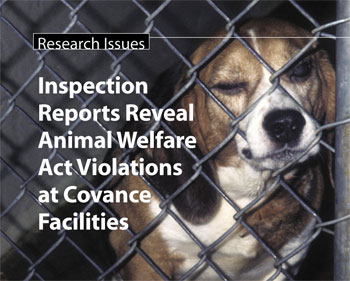
Disturbing new evidence of cruelty to animals at Covance Laboratories may foil the company’s plans to build a huge new animal-testing facility in Chandler, Ariz. The federal government recently fined Covance based on documented allegations of striking, choking, and tormenting primates at its Virginia facility. Company officials dismissed that abuse as an anomaly.
However, newly obtained U.S. Department of Agriculture inspection reports reveal that in 2005 alone, five other Covance facilities, operating as Covance Research Products, committed serious violations of the Animal Welfare Act. PCRM experts have produced a report based on these inspection documents, which reveal a wide array of problems.
Veterinary Care Violations
Two Covance facilities were cited in 2005 for having inadequate veterinary care. Rabbits at a Pennsylvania facility were denied proper veterinary care for months; USDA inspectors observed two rabbits showing clear signs of distress. Pigs at another facility could not move normally because their claws were so severely overgrown.
IACUC Violations
Under the Animal Welfare Act, every research facility must have an Institutional Animal Care and Use Committee (IACUC), which is charged with approving all research protocols at its facility and withholding approval on all protocols that do not comply with the law. The reports listed citations for all five Covance facilities for failure of the IACUC to properly adhere to the Animal Welfare Act. Specific violations included IACUCs approving protocols that failed to explain the rationale for using animals or the number used, approving protocol that failed to address the pain and distress the animals would experience, and IACUC members routinely being absent from meetings.
Sanitation, Enclosures, and Facilities Violations
A Covance facility in Berkeley, Calif., was cited for several violations, including hosing down dog enclosures while the dogs were still inside, holes in the floor of rabbit cages big enough for feet to get caught, and improper drainage.
Registration Violation
Animals at one Covance location were discovered by inspectors in an area within the facility that had not been reported, as required by law. If the inspectors had not happened upon the animals, the inspectors would not have been able to perform their legally mandated inspection of the animals’ treatment.
Covance has told the residents of Chandler that it operates with high regard for the welfare of animals and for the law. These claims have been disproven by the USDA inspectors’ independent reviews.
For more information, and for the USDA inspection reports, please visit www.ProtectChandler.org.
Take Action: Ask Your Senators to Support the Pet Safety and Protection Act
Please ask your senators to support Senate Resolution 451, the Pet Safety and Protection Act, which would prohibit Class B dealers from selling dogs and cats to laboratories for use in experiments. Some Class B animal dealers are known to have acquired animals through theft and deception and to have sold lost or stolen cats and dogs to experimenters and medical schools. The abuse of dogs and cats by Class B dealers is a serious problem and was detailed in the recent HBO documentary Dealing Dogs.
There are at least 93,000 cats and dogs in experimentation facilities, according to the U.S. Department of Agriculture’s Animal and Plant Health Inspection Service.
For more information about the Pet Safety and Protection Act and to e-mail your senators, please go to: http://support.pcrm.org/pet_safety. Or send a letter to your senators at:
Office of Senator (Name)
United States Senate
Washington, DC 20510